Research publications
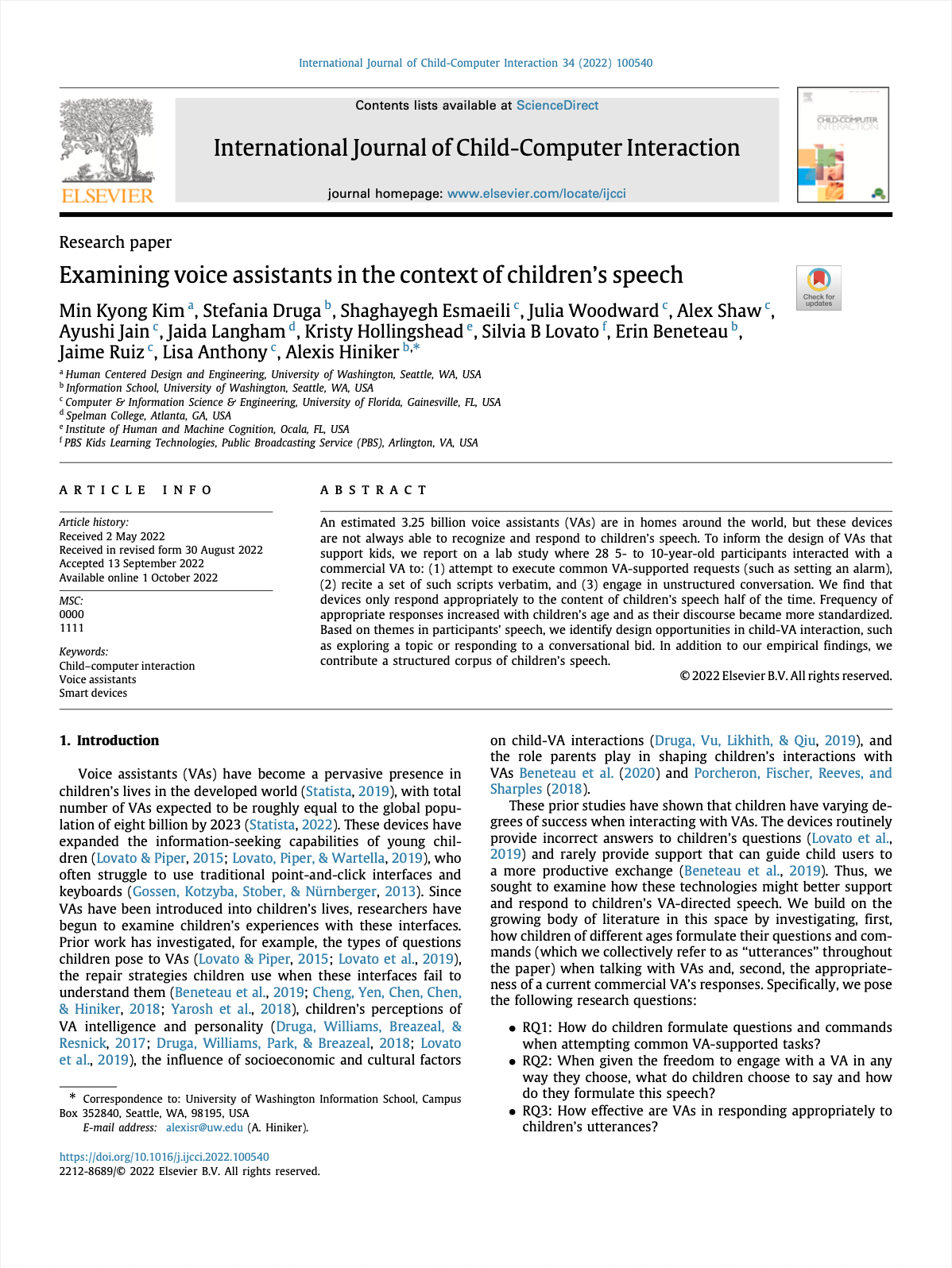
Examining Voice Assistants in the Context of Children's Speech
Papers published: International Journal of Child-Computer Interaction (2022)
Project Context
This project aimed to design and develop better interactions for children with voice interfaces. As a part of this project, we studied how kids interact with voice interfaces such as Amazon’s Alexa, Microsoft ‘s Cortana, Apple’s Siri and Google Assistant.
How do children formulate questions and commands when attempting common voice assistant (VA) tasks?
When given the freedom to engage with a VA, what do children choose to say and how do they structure that speech?
How effective are current commercial VAs in responding appropriately to children's utterances?
How do these interaction and formulation patterns change as children age?
Impact
Revealed that while transcription accuracy was relatively high (84%), devices only responded appropriately to the content of children's speech about 50% of the time, highlighting a major gap in the system's ability to interpret child-specific context.
Identified critical design opportunities for making VAs more inclusive for children, such as supporting collaborative topic exploration and better handling of social comments.
Contributed a structured corpus of over 10 hours of raw children's speech recordings to assist future researchers and developers in building more robust voice interfaces for younger users.
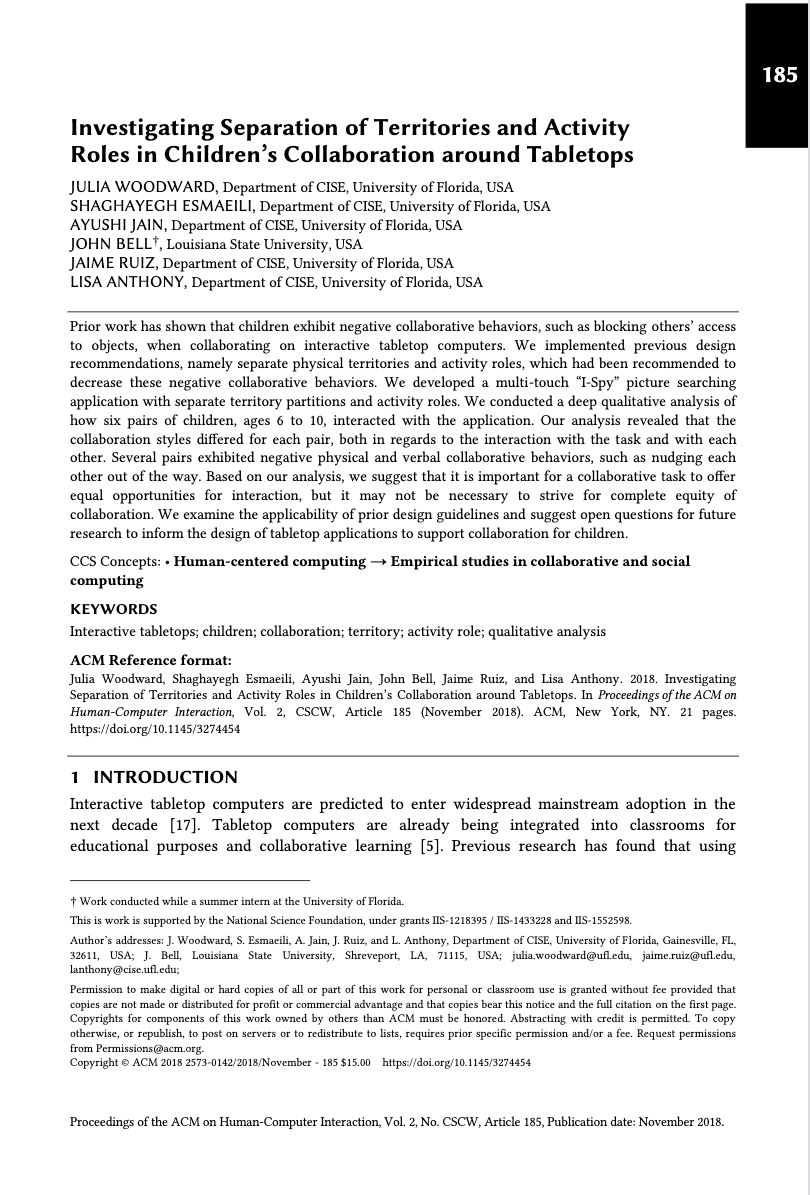
Studying Children’s Interactions with Tabletop Computers, Tablets and Smartphones
Papers published:
Investigating Separation of Territories and Activity Roles in Children's Collaboration around Tabletops in Proceedings of the ACM on Human-Computer Interaction;
Tablets, tabletops, and smartphones: cross-platform comparisons of children’s touchscreen interactions in ICMI ‘17: Proceedings of the 19th ACM International Conference on Multimodal Interaction
Project Context
This project aims to study how children interact with tabletop computers and provide better design recommendations to make these devices more user-friendly for the kids. As a part of this project, we designed and conducted user studies to gather data about touch and gesture interactions. The study includes researching various individual and collaborative aspects.
How do platform form factors (tablets, smartphones, and tabletops) and input modalities (pen vs. touch) influence the accuracy and efficiency of children’s interactions?
Can specific design frameworks, such as physical territory partitions and assigned activity roles, mitigate negative social behaviors like "blocking" during collaborative tabletop use?
How do these interaction patterns and collaborative styles evolve as children (ages 5–10) progress through key stages of cognitive development?
Impact
Established that touch-based input is significantly more effective for young users on tablets than pen input, leading to faster response times and improved accuracy
Challenged the assumption that "equal participation" is required for success; the research showed that inequitable "leader-follower" dynamics often produce high-quality outcomes with minimal social friction.
Contributed updated design frameworks to help developers build child-centric software that scales effectively from small-screen handhelds to large-scale collaborative surfaces