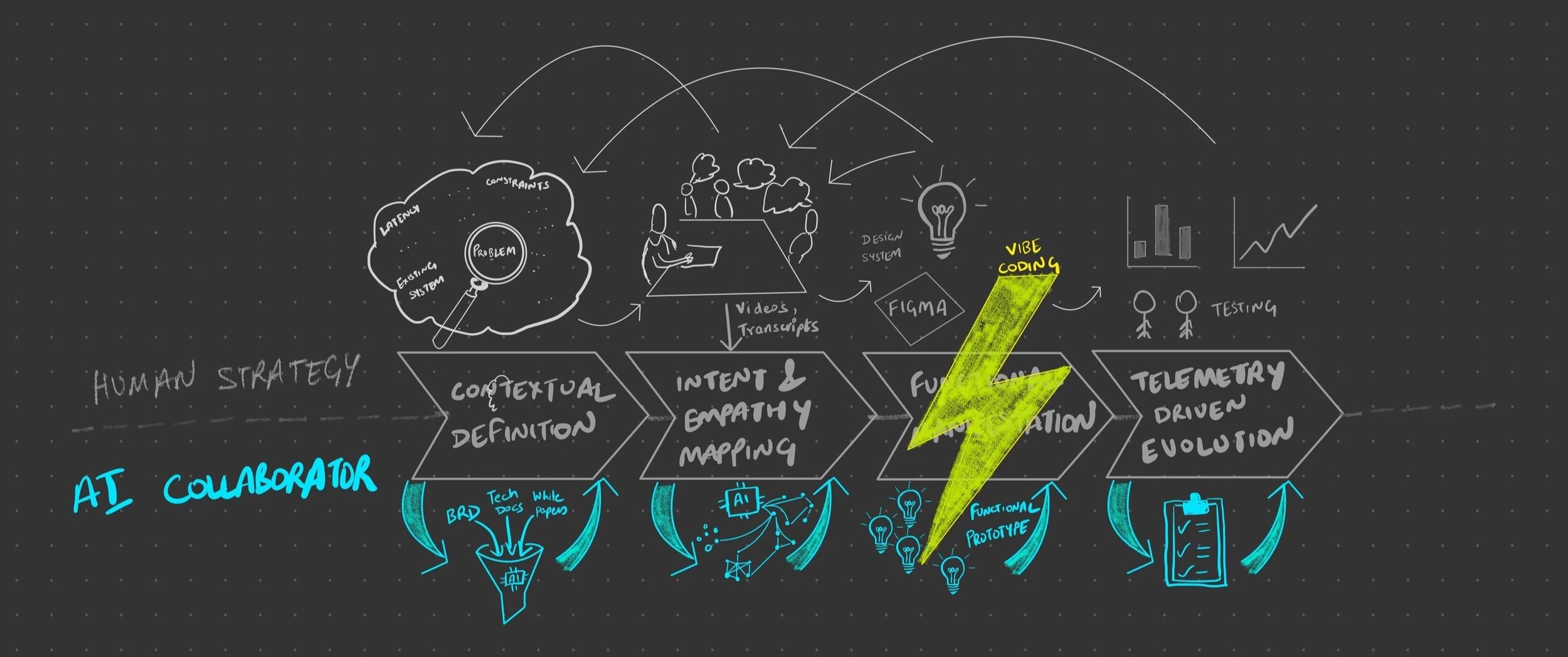
The 10x design loop : Human- centered, AI amplified
I don’t just design interfaces, I architect technical ecosystems. By integrating AI as a UX design collaborator, I collapse the distance between a raw requirement and a validated customer solution, allowing more space for strategic thinking and deep empathy.
Phase 1(a): Contextual Definition
Understanding the "Why" through a Technical Lens.
Every project begins with a deep dive into technical requirements and product specs. I use AI to synthesize massive documentation, highlighting critical constraints and surfacing the "unknown unknowns" that often hide in complex distributed backends.
Defining the Sandbox: I act as the lead investigator, using AI to distill massive noise into a focused set of technical guardrails.
Establishing Constraints: By understanding technical details like latency, reasoning boundaries, privacy and security guardrails, I ensure that every workflow is resilient, scalable and designed for the probabilistic nature of AI.
Phase 1(b): Intent and Empathy Mapping
Orchestrating empathy at scale to find the human signal in the noise.
With the technical boundaries set, I bring in the human element. I conduct deep-dive sessions with users, then leverage AI to synthesize thousands of qualitative data points - from interview transcripts to anecdotal data to support tickets - into a "Neural Constellation" of insights.
Insight Synthesis: I look for the nuanced insights that define what customers actually need versus what they ask for.
The Strategic North Star: Once the insights are clear, I build the scaffolding. I use AI to help generate and stress-test Personas, Jobs to be Done (JTBD), and Day-in-the-Life scenarios. I use AI to simulate edge cases and ensure the frameworks are resilient enough for high-scale complexity.
Phase 2: Functional Manifestation
Bypassing high-fidelity static mocks with functional "Vibes” to get immediate alignment.
This is where my engineering background meets my design practice. Depending on the project’s needs, I utilize vibe coding to jump directly from a concept to a functional prototype. This allows me to test technical feasibility in real-time, getting immediate alignment from leadership.
The Vibe Jump: I manifest live behaviors - testing how the design handles state changes, error recovery, and actual backend latency - to maintain faster feedback loop and alignment with Engineering and Product partners.
Rapid Validation: We put these functional prototypes in front of customers early, ensuring the solution solves the problem at a systems level before a single line of production code is written.
Phase 3: Telemetry driven evolution
Bypassing high-fidelity static mocks with functional "Vibes” to get immediate alignment.
Design doesn't end at handoff. During implementation, I partner with Product and Engineering to define the metrics that will track the feature's health. I believe a "beautiful" design is a failure if it doesn't move the needle for the business or the user.
Post-Launch Evaluation: After the feature is live, I use AI to analyze performance metrics and user sentiment, generating comprehensive reports that keep a pulse on feature health.
Continuous Evolution: These insights allow us to evaluate the feature’s performance objectively, closing the loop and informing the next iteration of the product.